The Sun Is Out I m Pure Again Meme
| Stanley Park | |
|---|---|
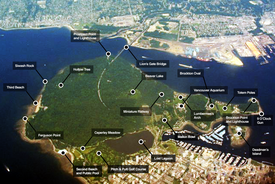 Aeriform view of Stanley Park | |
 | |
| Type | Urban Park |
| Location | Vancouver, British Columbia, Canada |
| Coordinates | 49°eighteen′N 123°08′W / 49.30°N 123.fourteen°Due west / 49.30; -123.14 Coordinates: 49°18′N 123°08′Due west / 49.30°N 123.14°Due west / 49.30; -123.14 |
| Surface area | 404.9 hectares (iv.049 km2; 1,001 acres; 1.563 sq mi) |
| Created | 1888 |
| Operated by | Vancouver Park Board |
| Visitors | approx. 81000000 annually[ane] |
| National Historic Site of Canada | |
| Official proper noun | Stanley Park National Historic Site of Canada |
| Designated | 1988 |

Map showing the location of the park within the city
Stanley Park is a 405-hectare (ane,001-acre) public park in British Columbia, Canada that makes up the northwestern half of Vancouver'due south Downtown Peninsula, surrounded by waters of Burrard Inlet and English Bay. The park borders the neighbourhoods of Due west End and Coal Harbour to its southeast, and is continued to the North Shore via the Lions Gate Bridge. The historic lighthouse on Brockton Indicate marks the park's easternmost point. While it is not the largest of its kind, Stanley Park is about one-5th larger than New York Metropolis's 340-hectare (840-acre) Central Park and nigh half the size of London's 960-hectare (ii,360-acre) Richmond Park.[2]
Stanley Park has a long history. The land was originally used past Indigenous peoples for thousands of years before British Columbia was colonized by the British during the 1858 Fraser Canyon Golden Rush and was i of the first areas to be explored in the metropolis. For many years after colonization, the future park with its abundant resources would too be home to non-Ethnic settlers. The land was later turned into Vancouver's first park when the city incorporated in 1886. It was named later Lord Stanley, 16th Earl of Derby, a British pol who had recently been appointed Governor General. It was originally known as Coal Peninsula and was set up bated for armed forces fortifications to guard the entrance to Vancouver harbour. In 1886 Vancouver urban center council successfully sought a lease of the park which was granted for $1 per twelvemonth. In September 1888 Lord Stanley opened the park in his name.[3] : 254
Unlike other big urban parks, Stanley Park is not the cosmos of a landscape builder, but rather the evolution of a forest and urban space over many years.[4] Nigh of the manmade structures present in the park were built between 1911 and 1937 under the influence of then superintendent West.S. Rawlings. Additional attractions, such as a polar conduct showroom, aquarium, and a miniature train, were added in the post-war menses.
Much of the park remains equally densely forested as it was in the belatedly 1800s, with nearly a half 1000000 trees, some of which stand every bit tall as 76 metres (249 ft) and are hundreds of years old.[5] [vi] Thousands of copse were lost (and many replanted) after three major windstorms that took place in the past 100 years, the last in 2006.
Significant effort was put into constructing the virtually-century-old Vancouver Seawall, which tin draw thousands of people to the park in the summer.[7] The park likewise features forest trails, beaches, lakes, children'south play areas, and the Vancouver Aquarium, amidst many other attractions. On June xviii, 2014, Stanley Park was named "height park in the entire earth" by TripAdvisor, based on reviews submitted.[8]
History [edit]
Coast Salish Land [edit]

Archaeological evidence suggests a human being presence in the park dating back more than iii,000 years.[9] [10] The area is the traditional territory of dissimilar coastal indigenous peoples. From the Burrard Inlet and Howe Audio regions, Squamish Nation had a large village in the park. From the lower Fraser River area, Musqueam Nation used its natural resources.[xi]
Where Lumberman'south Arch is now, there once was a big village called Whoi Whoi, or Xwayxway, roughly significant place of masks.[12] One longhouse, built from cedar poles and slabs, was measured at 61 metres (200 ft) long by 18 metres (60 ft) wide.[thirteen] These houses were occupied by large extended families living in unlike quadrants of the house. The larger houses were used for ceremonial potlatchs where a host would invite guests to witness and participate in ceremonies and the giving abroad of property.[fourteen]
Some other settlement was further due west along the same shore.[15] This place was called Chaythoos, significant high bank.[10] [12] The site of Chaythoos is noted on a brass plaque placed on the lowlands due east of Prospect Point commemorating the park's centennial.
Both sites were occupied in 1888, when some residents were forcefully removed to let a road to be constructed effectually the park, and their midden was used for construction fabric.
The popular landmark Siwash Rock, located near nowadays-mean solar day Third Beach, was once called Slahkayulsh meaning he is continuing up.[12] In the oral history, a fisherman was transformed into this stone by 3 powerful brothers as penalisation for his immorality.[12]
In 2010, the primary of the Squamish Nation proposed renaming Stanley Park equally Xwayxway Park afterward the large village in one case located in the surface area.[16]
European exploration [edit]
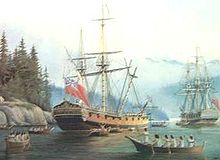
A painting of ships used in George Vancouver'due south exploration of the west declension of North America in his 1791–1795 expedition
The first European explorations of the peninsula occurred with Spanish Captain José María Narváez (1791) and British Captain George Vancouver (1792).
In A Voyage of Discovery, Vancouver describes the area as "an island ... with a smaller island Deadman's Island (the right proper noun being Deadman Isle) lying before information technology," suggesting that it was originally surrounded by water, at to the lowest degree at loftier tide.[17]
Helm Vancouver besides wrote about meeting the people living there:
Here we were met by about 50 [natives] in canoes, who conducted themselves with slap-up decorum and civility, presenting us with several fish cooked and undressed of a sort resembling smelt. These expert people, finding we were inclined to make some return for their hospitality, showed much understanding in preferring iron to copper.
According to historians,[ who? ] the natives probably get-go saw Captain Vancouver'south transport from Chaythoos, a location in the futurity park that in today'south terms lay simply due east of the Lions Gate Bridge (or Commencement Narrows Bridge equally it is sometimes called). Speaking about this consequence subsequently in a conversation with archivist Major Matthews, Andy Paull, whose family lived in the area, confirms the account given by Captain Vancouver:
Every bit Vancouver came through the Beginning Narrows, the [natives] in their canoes threw these feathers in corking handfuls before him. They would of course rise in the air, drift forth, and fall to the surface of the water, where they would rest for quite a time. It must have been a pretty scene, and duly impressed Captain Vancouver, for he speaks most highly of the reception he was accorded.[12]
No significant contact with inhabitants in the area was recorded for decades, until around the time of the Crimean War (1853–56). British admirals bundled with Master Joe Capilano that if there was an invasion, the British would defend the south shore of Burrard Inlet and the Squamish would defend the north.[18] The British gave him and his men 60 muskets. Although the attack anticipated by the British never came, the guns were used by the Squamish to repel an set on by an indigenous raid from the Euclataws. Stanley Park was not attacked, but this was when it started to be idea of as a strategic military position.[nineteen]
Early uses of park state [edit]

The peninsula was a popular identify for gathering traditional food and materials in the 1800s, but it started to run across even more activity after the Fraser Canyon Gold Blitz in 1858, going through a succession of uses when Not-Indigenous settlers moved into the area.
The shallow waters around the Offset Narrows and Coal Harbour were popular line-fishing spots for clams, salmon, and other fish. August Jack Khatsahlano, a historic dual master of the Squamish and Musqueam who once lived at Chaythoos, remembered how he used to fish-rake in Coal Harbour and take hold of many herrings.[14] They would also hunt grouse, ducks, and deer on the peninsula.
2nd Beach was a source of "clay ... which, when rolled into loaves, as (my people) did it, and heated or roasted before a burn down, turned into a white like chalk" that was used to brand wool blankets.[20]
Ethnic inhabitants also cutting down large cedar trees in the area for a variety of traditional purposes, such every bit making dugout canoes.[11]

By 1860, nonaboriginal settlers (Portuguese, Scots, and others) had started building homes on the peninsula, first at Brockton Point and subsequently on Deadman Island. "Portuguese Joe" Silvey was the first European to settle in the future park.[21] A Chinese settlement as well grew in a cleared expanse at Anderson Point (nigh the present twenty-four hours Vancouver Rowing Club).[22]
The peninsula was surveyed and made a war machine reserve in an 1863 survey completed past the Purple Engineers. Despite the houses and cabins on the state, it was again considered a strategic point in case Americans attempted an invasion and launched an assail on New Westminster (and so the colonial capital letter) via Burrard Inlet.

Springboard notched stumps attest to pre-park logging activities.
In 1865, Edward Stamp decided that Brockton Point would be an ideal site for a lumber mill. He cleared shut to forty hectares (100 acres) with the permission of colonial officials, but the site proved likewise impractical and he moved his operation due east, eventually condign Hastings Mill. The land cleared by Stamp afterwards became the Brockton sports fields.
The future park was selectively logged by six unlike companies betwixt the 1860s and 1880s, but its war machine status saved the country from further development.[23] Most of today'due south trails in Stanley Park got their showtime from the quondam skid roads.[nine]
Near the end of the 1800s, the city's principal reservoir was built in the area s of Prospect Point that is now a playing field and picnic area.[24] Despite the reservoir's demolition in 1948, at that place is still a Reservoir Trail at that location.
From the 1860s to 1880s, settlers in Burrard Inlet used Brockton Point, Anderson Signal, and nearby Deadman Island every bit burying grounds. This do stopped when the Mount View Cemetery opened in 1887. Deadman Island had already had a long history as a burial site. In 1865, unsuspecting newcomer John Morton found one-time cedar boxes in the trees.[25] They turned out to be coffins that had been placed in that location to go on the remains of important indigenous persons out of attain of wildlife.[fifteen]
Leasing the state [edit]

1887 map showing the area of the proposed park
In 1886, equally its first social club of business organization, Vancouver'south City Council voted to petition the dominion government to lease the military reserve for use as a park. To manage their new acquisition, city council appointed a six-person park committee, which in 1890 was replaced with an elected body, the Vancouver Park Lath.
In 1908, 20 years after the first lease, the federal government renewed the lease for 99 more years.[26]
In 2006, a letter from Parks Canada stated that "the Stanley Park lease is perpetually renewable and no activity is required by the Park Board in relation to the renewal."
Opening and dedication [edit]

Stanley Monument, unveiled 19 May 1960, depicting Stanley dedicating the Park "To the use and enjoyment of people of all colours and creeds and customs for all fourth dimension"
On September 27, 1888, the park was officially opened (although the legal status of Deadman Isle as office of the park would remain cryptic for many years). The park was named after Lord Stanley, who had recently get Canada's sixth governor general (and who is perhaps best known today for having donated the Stanley Loving cup that was afterward handed downwards to the National Hockey League).[1] Mayor David Oppenheimer gave a formal speech opening the park to the public and delivering authority for its direction to the park committee.[27] [28] [29]
The following year, Lord Stanley became the first governor general to visit Vancouver when he officially dedicated the park. Mayor Oppenheimer led a procession of vehicles around Brockton Signal along the newly completed Park Road to the clearing at Prospect Signal. An observer at the upshot wrote:
Lord Stanley threw his arms to the heavens, as though embracing within them the whole of thousand acres of primeval forest, and defended information technology "to the use and enjoyment of peoples of all colours, creeds, and community, for all time. I name thee Stanley Park."[30]

Eviction of pre-park residents [edit]

1928 photograph of the home of Tim Cummings, the last person to live at Brockton Betoken
When Lord Stanley fabricated his declaration, in that location were still a number of homes on lands he had claimed for the park. Some, who had built their homes less than twenty years before, would keep to alive on the land for years. Most were evicted by the park board in 1931, but the last resident, Tim Cummings, lived at Brockton Indicate until his death in 1958.[31]
Sarah Avison, the daughter of the first park ranger, recalled when the city evicted the Chinese settlers at Anderson Point in 1889:
The Park Board ordered the [Chinese settlers] to leave the park; they were trespassers; but [they] would not go, and so the Park Board told my father to set burn to the buildings. I saw them burn; there were five of united states children, and y'all know what children are like when in that location is a fire. Then male parent set burn to the shacks; what happened to the Chinese I do not know.[32]
About of the dwellings at Xwayxway were reported vacant past 1899, and in 1900, two of such houses were purchased past the Park Board for $25 each and burned. Ane Squamish family unit, "Howe Sound Jack" and Sexwalia "Aunt Sally" Kulkalem, connected to live at Xwayxway until Sally died in 1923. Sally'south ownership of the holding surrounding her home was accustomed past authorities in the 1920s, and following her decease, the belongings was purchased from her heir, Mariah Kulkalem, for $xv,500 and resold to the federal authorities.[24]
Although almost residents of the area were evicted by the early 20th century, the municipal government still owns a number of field homes used by the park's "live-in caretakers".[33] Caretakers that occupy the field homes are not charged rent by the city, although they are required to assist in park operations and provide a permanent presence for the park board.[33] In 2006, the Metropolis of Vancouver decided it would no longer supplant live-in caretakers that retired or moved out from the field homes; with the city opting to convert several unoccupied field homes into artist studios.[33]
Construction of Lost Lagoon and causeway [edit]
From 1913 to 1916, a lake was synthetic in a shallow part of Coal Harbour, a project that was not without its detractors. The lake was named Lost Lagoon due to its history of 'disappearing' at low tide. The lake and a causeway into the park were designed past Thomas Mawson, who also designed a lighthouse for Brockton Point around the same fourth dimension. Before the Causeway, a wooden footbridge provided the only access route into the park from Coal Harbour. Construction of the causeway (and new roads inside the park for emergency admission) was completed by 1926.[31]
In 1923, the saltwater pipes entering the lake from Coal Harbour were shut off, turning it into a freshwater lake. A lit fountain was later erected to commemorate the city'south golden jubilee. The fountain, installed in 1936, was purchased from Chicago, a leftover from its world's off-white in 1934.[34]
The causeway was widened and extended through the eye of the park in the 1930s with the construction of the Lions Gate Bridge, which connects downtown to the North Shore. At the aforementioned fourth dimension, two pedestrian subways were added under the Causeway at the entrance to the park from Georgia Street.
By the 1950s, visitors could accept rented rowboats on Lost Lagoon, only boating and other activities were banned in 1973 as the lake became a bird sanctuary. Past 1995, the old boathouse had been turned into the Lost Lagoon Nature House. It is operated by the Stanley Park Ecology Society, which is a non-profit arrangement that works aslope of the Vancouver Lath of Parks and Recreation to promote stewardship and conservation in Stanley Park.[35] [36] [37]

1917 panoramic view showing Lost Lagoon, the Stanley Park Causeway under structure, and the Vancouver Rowing Gild.

2017 panoramic view showing Lost Lagoon
Seawall [edit]

Construction of the 8.8-kilometre (5.5 mi) seawall and walkway around the park began in 1917 and took several decades to complete.[38] The original idea for the seawall is attributed to park board superintendent, W. S. Rawlings, who conveyed his vision in 1918:
It is non difficult to imagine what the realization of such an undertaking would mean to the attractions of the park and personally I incertitude if in that location exists anywhere on this continent such possibilities of a combined park and marine walk as we have in Stanley Park.[39]
James "Jimmy" Cunningham, a chief mason, dedicated 32 years of his life to the construction of the seawall from 1931 until his retirement in 1963. Cunningham continued to return to monitor the wall'southward progress until his expiry at 85.[39]
The walkway has been extended several times and is currently 22 kilometres (14 mi) from end to end, making it the world'southward longest uninterrupted waterfront walkway.[forty] The Stanley Park portion is merely under half of the unabridged length, which starts at Canada Identify in the downtown cadre, runs effectually Stanley Park, forth English Bay, around False Creek, and finally to Kitsilano Beach. From there, a trail continues 600 metres to the west, connecting to an additional 12 kilometres (7.v mi) of beaches and pathways which finish at the mouth of the Fraser River.
Pond pools [edit]

Second Embankment puddle in 1940
By 1932, there were ii seaside, saltwater pools in the park, one at 2d Beach and one at Lumberman's Arch. These "draw and fill" pools used sun-warmed water from the ocean. Once a calendar week the pool gates were opened at low tide to release the water back into the ocean, before the next high tide of make clean water.
For many years, children could take swimming lessons for gratuitous at Lumberman's Arch under the Vancouver Sun's Learn to Swim program. The puddle was filled in later on developing persistent bug and replaced with the current water spray park in 1987. The spray park, the largest of its kind in Vancouver, consists of a series of water geysers, showers, and cannons.
In 1995, after more than 60 years of functioning, the Second Beach pool was shut down because it failed to come across new health standards. By 1996, it had been replaced with the electric current heated pool.
At both locations, remnants of the former pool's semicircle shaped outer wall can still be seen.
In wartime [edit]

Map showing the location of WWII defence forts, including Ferguson Bespeak (Stanley Park)[41]
- See Listing of World War II-era fortifications on the British Columbia Coast
In Earth War I, a gun battery (without a bunker) was placed at Siwash Point (in a higher place Siwash Stone) to protect the metropolis from possible attacks from German merchant raiders.[42] It was removed merely prior to the cease of the war in 1918.[43]
In 1936, when the Empire of Japan began large-scale military repression in northeast Mainland china, the perceived Japanese threat resulted in fortifications being erected in Stanley Park, among other areas.[44] In Stanley Park, a watch tower was built on the cliff straight above Siwash Rock and remains intact as an ascertainment deck that is accessed from the trails above.
By 1940, a gun bombardment and bunker had been built at Ferguson Point, simply east of Third Beach. The military machine likewise expanded its utilise of the park by closing the expanse around Ferguson Point and Third Beach, where it had established barracks for the battery disengagement and was providing preparation.[45] [46] What is now the Teahouse eating house was originally congenital as an officers' mess.[34] The bunker was buried and bombardment removed around the end of the state of war.
The ground forces congenital several other coastal defence forts for the second World State of war, every bit shown in the illustration at correct, most notably at Tower Beach in Point Grey. In add-on, an test area was set up where whatsoever ships requesting entrance to the harbour had to end and submit to an inspection.[41]
Zoo and Children's Farmyard [edit]

A bear in the Stanley Park Zoo, which is now permanently closed
From the very beginning, the park kept and exhibited animals after the first park ranger, Henry Avison, captured an orphaned black bear cub and chained information technology to a stump for safe in 1888. Past 1905 several animals had been donated: a monkey, a large seal, 4 grass parakeets, a raccoon, a canary, and a black behave. Avison was subsequently named city pound keeper, and his drove of animals formed the basis for the original zoo, which eventually housed over 50 animals, including snakes, wolves, emus, bison, kangaroos, monkeys, and Humboldt penguins.[47]
By the 1970s, the zoo with its new polar bear exhibit, built in 1962, had get the park'due south principal attraction. Today the but remnant of the old zoo is a large concrete grotto where the polar bears had entertained crowds for many years until the 1990s. In 1994, when plans were developed to upgrade the zoo, Vancouver voters instead decided to phase it out when the question was posed in a plebiscite. The zoo was close down in 1996 and the animals were either moved to the petting zoo expanse, the Greater Vancouver Zoo in Aldergrove, or to other facilities.
The Stanley Park Zoo closed completely in December 1997 after the last remaining animal, a polar bear named Tuk, died at age 36. He had remained later on the other animals had left because of his old age. The polar bear grotto, often criticised past animal rights activists, was to be converted into a demonstration salmon spawning hatchery.[48]
The Stanley Park Children's Farmyard (petting zoo) opened in 1982. It was a successor to the original children's zoo that started in 1950. Domestic animals and a few reptiles and birds were kept in the Children's Farmyard until it closed in 2011.[49] [l]
Aquarium [edit]
The aquarium opened in 1956 due to complicated negotiations, followed by a massive expansion in 1967. It was the offset facility in the world to study a killer whale (1964); its researchers discovered a new species of shrimp in the Gulf Islands (1997); and it became the first aquarium to ensure that it would never result in the capture of a wild whale or dolphin (1996).[34] The popular children'south song "Baby Beluga" was inspired by one of the whales at the facility.
In 2006, the park board approved an $80one thousand thousand expansion of the facility, following considerable public debate and despite a vocal opposition concerned about animate being rights and the loss of park trees required by the expansion.[51]
1960s counterculture [edit]
By the 1960s, the neighbourhood around Stanley Park was similar to present day Commercial Bulldoze, attracting many of the city's beatniks and bloom children. This made Stanley Park the perfect place for exist-ins, a type of counterculture consequence inspired by the Human Be-In started in San Francisco. The Stanley Park result started on Easter weekend in 1967 and took identify each spring until the mid-1970s, when about of the counterculture movement had fizzled out. At its peak, thousands would assemble at Ceperley Meadows near Second Beach to listen to bands, speakers, and poets, and socialize.[52] [53]
Storms and loss of landmark copse [edit]
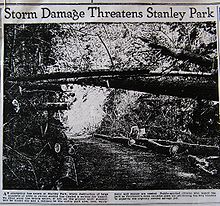
Vancouver Province photo of debris left by 1934–1935 storms and warning of the burn hazard if not cleaned up
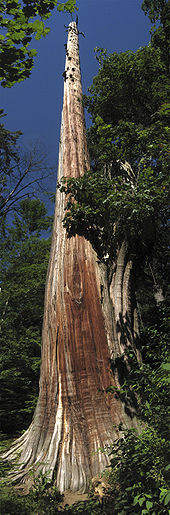
Fierce windstorms have struck Stanley Park and felled many of its copse numerous times in the by. Between 1900 and 1960, nineteen separate windstorms swept through the park, causing significant damage to the forest cover. The park lost some of its oldest trees through major storms twice in the last century and and then over again in 2006. The starting time was a combination of an October windstorm in 1934 and a subsequent snowstorm the following January that felled thousands of trees, primarily betwixt Beaver Lake and Prospect Point.[54] [55]
Some other storm in Oct 1962, the remnants of Typhoon Freda, cleared a 2.four-hectare (6-acre) virgin tract backside the children'southward zoo, which opened an area for a new miniature railway that replaced a smaller version built in the 1940s. In total, approximately 3,000 trees were lost in that storm.[56]
One stand of tall trees in the centre of the park did non survive beyond the 1960s after becoming a pop tourist attraction. The "Vii Sisters" are memorialized by a plaque and young replacement trees in the same location along Lovers Walk, a forest trail that connects Beaver Lake with 2nd Beach. "They were so popular that people basically killed them by walking on their roots," says historian John Atkin.[31]
The death of the distinctive fir tree atop Siwash Rock has also been memorialized with a replacement. The original died in the dry out summer of 1965, and through the persistent efforts of park staff, a replacement finally took root in 1968.[57] [58]

Trees growing out of stumps testify the regeneration of the park forest.
Another major windstorm ravaged the park on December 15, 2006, with 115 kilometres per 60 minutes (71 mph) winds (Hanukkah Eve windstorm). Over 60% of the western edge was damaged; the worst function was the area around Prospect Point.[59] In total, nigh 40% of the forest was afflicted, with an estimated ten,000 trees downed.[60] Large sections of the seawall were likewise destabilized past the storm, and many areas of the park were closed to the public pending restoration. The toll of restoration has been estimated at $91000000, which was covered by contributions from all three levels of government and private and corporate donations.[61]
Two landmark copse were affected. Ane tree that has achieved a lot of fame is the National Geographic Tree, and so named because information technology appeared in the magazine'south October 1978 result. With a circumference of xiii.5 m (44+ 1⁄two ft), it was in one case 1 of the more impressive big western carmine cedars of the park. It diminished over time, ravaged by storms, a lightning strike, and topped by park staff to a peak of 39.6 metres (130 ft) before existence uprooted in October 2007.[62] [63] [64]
The Hollow Tree was probably the virtually photographed park element in bygone years, an obligatory stop for locals, tourists and dignitaries alike, and a professional person lensman was on paw to capture the visit for a fee. The tree was saved from road widening in 1910 through the lobbying efforts of the photographer who fabricated his living at the tree.[65] Automobiles and horse-drawn carriages would frequently be backed into the hollow, demonstrating the immensity of the tree for posterity. While the remaining 700- to 800-year-old stump withal draws viewers and is commemorated with a plaque, it is no longer alive and has shrunk considerably over the years, from a circumference of 18.3 metres (60 ft) many decades agone, to a more than recent 17.1 metres (56 ft).[62] [63] Damaged past the December 2006 windstorm and leaning forwards at a dangerous angle, on March 31, 2008, the tree was targeted by the Vancouver Park Board for removal due to potential prophylactic hazards.[66] However, on Jan 19, 2009, the Board accepted a proposal to save the tree by realigning and stabilizing information technology at a cost of $250,000, funded entirely by private donations.[67]
Today [edit]
The wood continues to give the park a more than natural character than most other urban parks, leading many to telephone call it an urban oasis.[68] It consists of primarily 2nd and third growth and contains many tall Douglas fir, western red cedar, western hemlock, and Sitka bandbox copse. Since 1992, the tallest trees have been topped and pruned past park staff for rubber reasons.
A big variety of animals live in the park. There are 200 bird species alone, including many water birds. A large smashing blue heron colony moved into the park in 2001 and has grown to at present most 170 active nests.[69] Mammals include a big raccoon population, coyotes, skunks, beavers, rabbits descended from discarded pets, and a thriving grayness squirrel population (descended from eight pairs acquired from New York's Cardinal Park in 1909).[62] [68] However, there is a complete absenteeism of large mammals including deer, elk, deport, wolves, cougars, and bobcats.[lxx]
In that location have been occasional attacks by coyotes on humans in the park, but in the nine months from December 2020, during the 2022 covid pandemic, there was a major increase in frequency; forty attacks by the estimated twelve coyotes in the park, none fatal, took place, 4 times more than all the attacks in the previous thirty years. No explanation had been found every bit of August 2021[update], not fifty-fifty whether the attacks were by one coyote or dissimilar animals. Several coyotes were killed, merely the frequency of attacks did non decrease.[71]
Stanley Park too has many manmade attractions. Recreational facilities are especially abundant in the park, having long coexisted, albeit uneasily, with the aesthetic and more natural park features preferred by those looking to the park as an enclave of nature in the city.[72]
Recognition [edit]
The park was designated a National Historic Site of Canada past the federal government in 1988. It was deemed significant because the human relationship betwixt its "natural environmental and its cultural elements developed over time" and because "information technology epitomizes the large urban park in Canada."[73]
Stanley Park was named the best park in the world in 2013, co-ordinate to website TripAdvisor's start ever Travellers' Option Awards. Cardinal Park in New York took second identify and Colorado'south Garden of the Gods was third place.[74]
Attractions [edit]
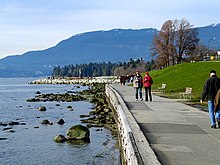
The Vancouver Seawall is pop for walking, running, cycling, inline skating, and even fishing (with a licence). At that place are two paths, one for skaters and cyclists and the other for pedestrians. The lane for cyclists and skaters goes one-style in a counterclockwise loop.[39] Walking the entire loop around Stanley Park takes about two hours, while biking information technology takes almost one hour.
There are besides more than than 27 kilometres (17 mi) of forest trails within the park.[75] Woods trails are patrolled by members of the Vancouver Constabulary Department on horseback.[76] The Mounted Unit'due south youth outreach includes offer guided tours of the stables and the 'Collector's Trading Card Program,' which encourages children of all ages to arroyo a lawman on horseback and request a menu.

Stanley Park's popular miniature railway
The 20 in (508 mm) narrow-approximate[77] Stanley Park Railway, a rideable miniature railway with different seasonal themes, is a Vancouver tradition, specially for families with young children. The original railway, started in 1947, featured a kid-sized train. The current adult-sized railroad opened in 1964 in an area leveled by Draft Freda. The engine is a replica of the first transcontinental passenger train to arrive in Vancouver in the 1880s.[78]
The windstorm of 2006 revealed traces of a long-forgotten rock garden, which had once been one of the park's star attractions and 1 of its largest man-fabricated objects by area.[79] [80] Shortly later on its discovery, a section that encircles function of the Stanley Park Pavilion was restored (the garden had originally extended from Pipeline Road to Coal Harbour).[81]

Beaver Lake is a restful space nestled amongst the trees. The lake is almost completely covered with water lilies (introduced for the Queen's Jubilee in 1938) and home to beavers, fish, and water birds. As of 1997, its surface surface area was just short of 4 hectares (10 acres), just the lake is slowly shrinking in size.[82] One of Vancouver's few remaining free-flowing streams, Beaver Creek, joins Beaver Lake to the Pacific Ocean and is 1 of two streams in Vancouver where salmon still return to spawn each year.[82] [83]

Lost Lagoon, the captive 17-hectare (41-acre) freshwater lake about the Georgia Street entrance to the park, is a nesting basis to many bird species, such equally Canada geese, and ducks.
The Vancouver Aquarium is the largest in Canada and houses a collection of marine life that includes dolphins, belugas, sea lions, harbour seals, and sea otters. In total, in that location are approximately 300 species of fish, 30,000 invertebrates, 56 species of amphibians and reptiles, and around 60 mammals and birds.[84] The aquarium is as well home to a 4D theatre.
The oldest manmade landmark in the park is an 1816 naval cannon located virtually Brockton Point. The Nine O'Clock Gun, as it is known today, was fired for the first time in 1898, a tradition that has continued for more than 100 years.[34] The cannon was originally detonated with a stick of dynamite, but is at present activated automatically with an electronic trigger.
Stanley Park as well has playgrounds, sandy beaches, gardens, tennis courts, an 18-hole pitch and putt golf class, a seaside pond pool, a water spray park, and Brockton Oval, which is used for track sports, rugby, and cricket.
In summertime, at that place is an outdoor theatre Malkin Basin, which features events by Theatre Under the Stars and Live Nation (with their Concerts in the Park series).[ii]
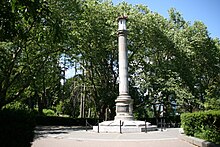
The Japanese Canadian War Memorial was erected through private donations in retention of Japanese Canadians who served in World War I.[85]
Monuments [edit]

The President Harding Memorial
The park has a large number of monuments, including statues, plaques, and gardens. Among these are the Japanese Canadian War Memorial (a cenotaph and two rows of Japanese ruby Prunus Shirotae copse) and statues of poet Robert Burns, Olympic runner Harry Jerome, and Girl in a Wetsuit.
The park board has banned the erection of any farther memorials to ensure that Stanley Park is kept in a more than natural country (and based on the view that it is already saturated). Equally an exception to the ban, the park board agreed in 2006 to build a new playground at Ceperley Meadows nigh 2d Beach honouring the victims of the Air India Flying 182 bombing. The federal government spent approximately $800,000 to build the memorial and playground.[86]

Slap-up blueish herons [edit]
Stanley Park is dwelling house to 1 of the largest urban great bluish heron colonies in North America, and the birds take been documented nesting in various locations in Stanley Park as far back as 1921. Great blueish herons are classified as a species at adventure in BC, and the Stanley Park Ecology Society has been monitoring the heronry in Stanley Park since 2004.[87] An estimated 156 young Pacific groovy bluish herons fledged from the colony in 2013.[88] Since monitoring started in 2007, the highest number of groovy blue herons fledged in a yr were 258, in 2007. The everyman number of fledges was in 2011 with merely 99 of the birds fledged.[89]
See also [edit]
- List of attractions and monuments in Stanley Park
- Timeline of Vancouver history
References [edit]
- ^ a b "Vancouver Park Board Parks and Gardens: Stanley Park". Retrieved 2008-06-15 .
- ^ a b Foss, Lindsay. "A Walk through Stanley Park". Travel. Canadian Geographic. Archived from the original on June 20, 2007. Retrieved 2006-12-ten .
- ^ Akrigg, G.P.5.; Akrigg, Helen B. (1986), British Columbia Place Names (3rd, 1997 ed.), Vancouver: UBC Press, ISBN0-7748-0636-ii
- ^ Stephan, Neb; Vancouver Natural History Guild (2006). Wilderness on the Doorstep: Discovering Nature in Stanley Park. Vancouver: Harbour Publishing. p. 17. ISBN1-55017-386-3.
- ^ Parkinson, Alison; Taylor, Terry; Vancouver Natural History Social club (2006). Wilderness on the Doorstep: Discovering Nature in Stanley Park. Vancouver: Harbour Publishing. pp. 54, 52. ISBN1-55017-386-3.
- ^ "Welcome to Stanley Park". Parks and Gardens. Vancouver Park Board. Archived from the original on 2006-09-27. Retrieved 2006-12-20 .
- ^ "Stanley Park Cycling Program". Urban center of Vancouver. Retrieved 2013-08-15 .
- ^ "World Park Rankings". Global News. Retrieved 2014-06-18 .
- ^ a b Kheraj, Sean. "Historical Overview of Stanley Park" (PDF). Stanley Park Ecology Society. Retrieved 2013-08-15 .
- ^ a b Shore, Randy (March 17, 2007). "Earlier Stanley Park: Kickoff nations sites lie scattered throughout the surface area". The Vancouver Sun . Retrieved 2013-08-15 .
- ^ a b Barman, Jean (2007) [2005]. Stanley Park's Secret: The Forgotten Families of Whoi Whoi, Kanaka Ranch and Brockton Point. Madeira Park, BC: Harbour Publishing. p. xx. ISBN 978-1-55017-420-5.
- ^ a b c d eastward "Early Vancouver Volume ii: Narrative of Pioneers of Vancouver, BC Collected During 1932". City of Vancouver. Retrieved 2013-08-16 .
- ^ Barman, Jean (2007) [2005]. Stanley Park'southward Undercover: The Forgotten Families of Whoi Whoi, Kanaka Ranch and Brockton Point. Madeira Park, BC: Harbour Publishing. p. 46. ISBN 978-1-55017-420-v.
- ^ a b Barman, Jean (2007) [2005]. Stanley Park'south Secret: The Forgotten Families of Whoi Whoi, Kanaka Ranch and Brockton Point. Madeira Park, BC: Harbour Publishing. p. 43. ISBN 978-ane-55017-420-5.
- ^ a b "Conversations with Khahtsahlano 1932-1954". City of Vancouver. Retrieved 2013-08-sixteen .
- ^ "Natives urge Stanley Park name change". CBC News. 2010-07-01.
- ^ Nicol, Eric (1970). Vancouver. Toronto: Doubleday. p. thirteen.
- ^ Nicol, Eric (1970). Vancouver. Toronto: Doubleday. pp. 15–sixteen.
- ^ Paull, Andy (26 March 1938). "The Battle-Footing of Stanley Park". Vancouver Sun.
- ^ Barman, Jean (2007) [2005]. Stanley Park'south Secret: The Forgotten Families of Whoi Whoi, Kanaka Ranch and Brockton Point. Madeira Park, BC: Harbour Publishing. p. 21. ISBN 978-1-55017-420-5.
- ^ "Stanley Park Timeline created by John Atkin". Vancouver Park Board. Retrieved 2013-08-17 .
- ^ Sherlock, Tracy (17 August 2013). "Looking back at our favourite park". The Vancouver Sun. Archived from the original on 2013-09-21. Retrieved 15 September 2013.
- ^ "Forest – Monument Trees". Stanley Park Nature. City of Vancouver. Archived from the original on September 30, 2007. Retrieved 2006-12-twenty .
- ^ a b Historical and Geographical Contexts, Stanley Park Commemorative Integrity Statement, Parks Canada.
- ^ Steele, Richard M. (1993). The Stanley Park explorer (Stanley Park ed.). Heritage House Publishing Co. ISBN1-895811-00-vii. OL 24831611M. 1895811007.
- ^ "The History of Metropolitan Vancouver: 1908". Retrieved 2008-06-15 .
- ^ Steele, R. Mike (1988). The Vancouver Lath of Parks and Recreation: The Showtime 100 Years. Vancouver Lath of Parks and Recreation. p. iii.
- ^ Kheraj, Sean (2008). "Improving Nature: Remaking Stanley Park'south Forest, 1888-1931" (PDF). BC Studies. 158: 63–90. Retrieved 2017-01-eleven .
- ^ Kheraj, Sean (2013). Inventing Stanley Park: An Environmental History. Vancouver: UBC Press. pp. 63–75.
- ^ Davis, Chuck; Conn, Heather (1997). The Greater Vancouver Book: An Urban Encyclopedia. Surrey, BC: Linkman Press. p. 52. ISBNane-896846-00-nine. Archived from the original on 2009-06-20.
- ^ a b c Mackie, John (Baronial 17, 2013). "Stanley Park, the natural wonder of Vancouver, was shaped by humans". The Vancouver Sun . Retrieved 2013-08-17 .
- ^ Kheraj, Sean. "Creature Comforts: Remaking the Fauna Landscape of Vancouver'southward Stanley Park, 1887-1911" (PDF). University of Toronto. Retrieved 15 September 2013.
- ^ a b c Redekop, Arlen (iii Nov 2014). "Last of the alive-in caretakers: Vancouver park workers will be last to stay rent-gratuitous in idyllic fieldhouses". National Mail. Postmedia Network. Retrieved eleven April 2021.
- ^ a b c d Davis, Chuck (April 4, 2010). "124 Years of Vancouver Oddities". The Vancouver Lord's day . Retrieved 2013-08-18 .
- ^ "Stories from inside the park: Historical glimpses of park attractions and businesses". Retrieved 2014-04-07.
- ^ "Stanley Park Environmental Society (SPES)".
- ^ "Stanley Park Ecology Society".
- ^ "Last stone laid in park's seawall". Vancouver Dominicus. 27 September 1971.
- ^ a b c Griffin, Kevin; Clark, Terri (4 Feb 2005). "Grand Old Man of the Seawall". Vancouver Sun.
- ^ Pleiff, Margo (2005-05-15). "Vancouver seawall links city'south urban and natural delights". San Francisco Chronicle . Retrieved 2006-12-01 .
- ^ a b Platt, Brian (December 5, 2011). "Pearl Harbour 70th Anniversary: Fortress UBC". The Ubyssey. Archived from the original on 2013-09-27. Retrieved 2013-08-22 .
- ^ Kheraj, Sean (2013). Inventing Stanley Park: An Environmental History. Vancouver, BC: UBC Press. p. 164. ISBN978-0-7748-2426-2.
Military authorities chop-chop delivered two four-inch-calibre guns from Esquimalt and installed them at the Siwash Indicate picnic grounds, not far from Siwash Rock.
- ^ Kheraj, Sean (2013). Inventing Stanley Park: An Environmental History. Vancouver, BC: UBC Press. p. 165. ISBN978-0-7748-2426-two.
By the terminate of April, the picnic area had been completely restored, except for the platforms, which remained in place until they were sold in Oct 1917.
- ^ Muir, Stewart (March 15, 2012). "Role 6: Military leaders insisted Japan was no threat to West Coast". The Vancouver Sun . Retrieved March fifteen, 2012.
- ^ "CWACs & the Paparazzis". Nov 27, 2011. Archived from the original on 2013-08-15. Retrieved 2013-08-18 .
- ^ Kheraj, Sean (2013). Inventing Stanley Park: An Environmental History. Vancouver: UBC Printing. Retrieved 2013-08-eighteen .
- ^ Steele, R. Mike (1988). Vancouver Board of Parks and Recreation: The Starting time 100 Years. Vancouver: Vancouver Board of Parks and Recreation. p. 13.
- ^ "Vancouver residents say no to Stanley Park Zoo". Edmonton Journal. 28 April 1996.
- ^ "Vancouver petting zoo, conservatory face cuts". CBC News. 18 November 2009. Retrieved 16 September 2013.
- ^ Fralic, Shelley (7 January 2011). "Closure of Stanley Park's petting zoo is PC madness". The Vancouver Dominicus. Archived from the original on 2013-09-21. Retrieved 16 September 2013.
- ^ Vancouver Park Board (2006-eleven-27). "Board of Parks and Recreation Special Lath Meeting". Vancouver Park Board. Archived from the original on 2007-09-30. Retrieved 2006-12-28 .
- ^ "Be-In Music Festival – Vancouver Canada". Voices of Eastward Anglia. Archived from the original on 2013-07-13. Retrieved 13 September 2013.
- ^ Smith, Charlie (Baronial 21, 2013). "Vision Vancouver boosts live music in local parks". The Georgia Direct . Retrieved 13 September 2013.
- ^ "The Harm in the Park". Vancouver Daily Province. 9 February 1934.
- ^ Kheraj, Sean (2007). "Restoring Nature: Environmental, Retentivity, and the Storm History of Vancouver'southward Stanley Park". Canadian Historical Review. 88 (4): 577–612. doi:10.3138/chr.88.4.577.
- ^ Hazlitt, Tom (22 May 1964). "It's for real – this railroad". Vancouver Daily Province.
- ^ "Park Tree'south Loss Stirs Memories". Vancouver Sunday. x Baronial 1965.
- ^ "Park Nonetheless Feels Frieda's Punch". Vancouver Sun. 6 August 1968.
- ^ Rook, Katie (2006-12-19). "Stanley Park 'looks like a war zone'". National Post. Archived from the original on 2007-03-thirteen. Retrieved 2006-12-20 .
- ^ Ellison, Marc (six December 2011). "Stanley Park five years later the storm". The World and Post . Retrieved 16 September 2013.
- ^ "Stanley Park restoration toll rises to $9million". Vancouver Sun. 2007-01-27. Archived from the original on 2013-09-21. Retrieved 2007-02-08 .
- ^ a b c Steele, Mike (1993). Vancouver's Famous Stanley Park: The Year-Round Playground. Vancouver: Heritage House. p. 108. ISBNane-895811-00-7.
- ^ a b Parkinson, Alison (2006). Wilderness on the Doorstep: Discovering Nature in Stanley Park. Vancouver: Harbour Publishing. p. 46. ISBN1-55017-386-3.
- ^ "Ancient cedar falls in Vancouver's Stanley Park". CBC. 2007-ten-eleven. Retrieved 2007-ten-11 .
- ^ Koshevoy, Himie (7 June 1962). "Saga of Stanley Park". Vancouver Daily Province.
- ^ "Stanley Park's hollow tree gets the axe." CBC News. Apr 1, 2008.
- ^ "Stanley Park's Hollow Tree spared the axe for adept." CBC News. January 19, 2009.
- ^ a b "Stanley Park – Vancouver's Urban Oasis" (PDF). Tourism Vancouver. Archived from the original (PDF) on 2006-12-xxx. Retrieved 2006-12-20 .
- ^ "Vancouver's Great Blue Herons". Stanley Park Ecology Society . Retrieved October 6, 2017.
- ^ "State of the Park Report for the Ecological Integrity of Stanley Park" (PDF). Stanley Park Ecology Society. Retrieved 2013-08-25 .
- ^ Cecco, Leyland (24 August 2021). "Mystery over surge in coyote attacks in Vancouver park". The Guardian.
- ^ McDonald, Robert A. J. (1984). ""Holy Retreat" or "Practical Animate Spot"? Class Perceptions of Vancouver's Stanley Park, 1910–1913". Canadian Historical Review. LXV (2): 139–140. doi:10.3138/chr-065-02-01.
- ^ Parks Canada/Vancouver Board of Parks and Recreation (2002-xi-26). "Stanley Park: Commemorative Integrity Statement" (PDF). Archived from the original (PDF) on 2007-07-04. Retrieved 2006-12-28 .
- ^ Ip, Stephanie (29 June 2013). "Vancouver'south Stanley Park named globe'southward all-time park". The Province. Archived from the original on 2013-09-16. Retrieved 16 September 2013.
- ^ "Stanley Park Trails". Metropolis of Vancouver. Retrieved 2013-08-xiv .
- ^ "The Mounted Squad Today". Mounted Squad, Patrol District One. Vancouver Constabulary Department. Retrieved 2006-12-16 .
- ^ [KidsVancouver.com - Stanley Park Train - Miniature Railway]
- ^ "Stanley Park Miniature Railroad train". City of Vancouver. Retrieved 2013-08-26 .
- ^ Hasiuk, Mark (2007-02-06). "Wind exposed more than of celebrated rockery". Vancouver Courier. Archived from the original on September 27, 2007. Retrieved 2007-03-10 .
- ^ O'Connor, Naoibh (2006-08-18). "Lost garden of Stanley Park". Vancouver Courier. Archived from the original on October eighteen, 2006. Retrieved 2007-03-ten .
- ^ "Celebrated Stanley Park Stone Garden Returns". Global News. 2013-08-16. Retrieved August 20, 2013.
- ^ a b "Beaver Lake Ecology Enhancement Project" (PDF). Vancouver Park Board. 1997-05-30. Retrieved 2008-07-22 .
- ^ Hume, Mark (December 2000). "The Lost Streams". Archived from the original on 2008-05-13. Retrieved 2008-07-22 .
- ^ "Aquafacts – Oft Asked Questions". Vancouver Aquarium. Archived from the original on 2006-09-28. Retrieved 2006-12-28 .
- ^ "Japanese War Memorial Stanley Park". National Inventory of Canadian Military Memorials. National Defense force Canada. 2008-04-16. Archived from the original on 2014-05-29. Retrieved 28 May 2014.
- ^ Kittleberg, Lori (2006-07-06). "Air India tribute proposed for Ceperley Park". Xtra Due west!. Retrieved 2006-12-x .
- ^ "Vancouver's Great Blue Herons". Stanley Park Ecological Society. Retrieved 5 November 2014.
- ^ "Pacific dandy blue herons return to Stanley Park after successful 2013 season". City of Vancouver. 10 March 2014. Retrieved 5 November 2014.
- ^ Straker, Dan (Dec 2013). "Stanley Park Great Blueish Heronry Annual Report 2013" (PDF). Stanley Park Ecology. p. 4. Retrieved 5 November 2014.
Further reading [edit]
- Grant, Paul; Dickson, Laurie (2003). The Stanley Park Companion. Winlaw, B.C.: Bluefield. ISBN1894404165.
- Steele, Richard Thousand. (1993). Stanley Park. Surrey, B.C.: Heritage House. ISBN1895811007.
Fiction [edit]
- Taylor, Timothy (2001). Stanley Park . Toronto, ON: Vintage Canada. ISBN0676973094.
- Lowry, Malcolm (2009). The Bravest Gunkhole. Hear U.s. O Lord from Sky Thy Dwelling Identify. Don Mills, ON: Oxford University Press. ISBN9780195430066.
External links [edit]
- Official websites
- Welcome to Stanley Park – City of Vancouver website
- Downloadable Maps – City of Vancouver website
- Story of Stanley Park – Metropolis of Vancouver website
- Hereafter of Stanley Park – City of Vancouver website
- Park Ecology - Stanley Park Ecology Order website
- Stanley Park (silent highlight reel made over the 1930s-50s) - City of Vancouver Archives website
- Our Outdoor Heritage (silent highlight reel made in 1940) - Metropolis of Vancouver Archives website
- Stanley Park Collection - A collection of threescore glass plate negatives from the UBC Library Digital Collections documenting Vancouver's Stanley Park in 1912
- Additional information
- Stanley Park Invasive Plants - Immigration of invasive plants by contained volunteers
- Interactive Map - Heart of the Park: Stanley Park celebrates 125 years - CBC website
- Archive Photos of Stanley Park - Miss 604 website
- On the Spot (short film nearly the Stanley Park Zoo in 1953) - National Film Lath website
- Stanley Park, the natural wonder of Vancouver, was shaped by humans (2013) - Vancouver Lord's day commodity
- In the Shadows: the Darker Side of Stanley Park (2013) - World and Mail commodity
- The Secrets of Stanley Park (2013) - Vancouver Sun article
- History has forgotten existence of a thriving First Nations customs in Stanley Park (2013) - The Province article
- Stanley Park page, Vancouver And so and Now website, comparisons of today'southward park with older photos
Source: https://en.wikipedia.org/wiki/Stanley_Park

Post a Comment for "The Sun Is Out I m Pure Again Meme"